
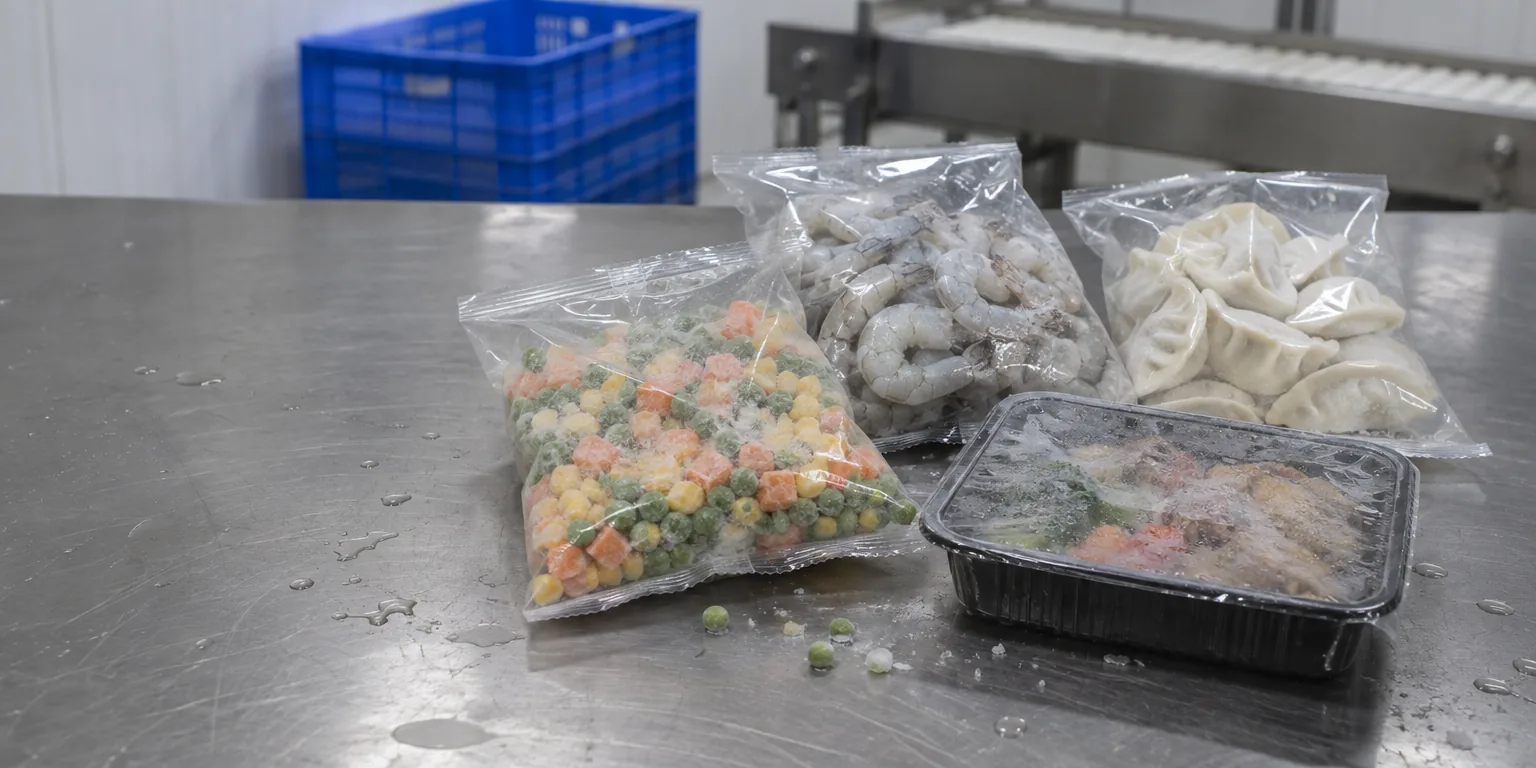
What Frozen Food Packaging Has to Do
Good frozen food packaging keeps air away from the product, stays tough at freezer temperatures, seals cleanly with ice and frost around, and holds up through the cold chain. It also carries the label: net weight, storage and cooking instructions.
Keep the product from drying out
Freezer burn is the classic failure. The USDA describes it as grayish-brown, leathery spots caused by air reaching the surface of the food. It doesn't make the food unsafe, but it ruins how it looks and eats (USDA FSIS, Freezing and Food Safety).
Temperature swings make it worse. Each time the pack warms above 0°F (−18°C) in distribution, at retail or in a home freezer, moisture moves from the product into the air in the pack, then freezes again as ice crystals (IFT Food Technology, 2019). Less air in the pack means less room for that to happen, which is why vacuum and skin packs suit some frozen products. For a bag, it means a film that holds moisture in and a seal that stays closed.
Stay tough in the cold
Some plastics turn brittle in the freezer. The same IFT article recommends testing packaging at the temperature it will be used at, and gives polypropylene bread bags as an example: they puncture easily once they go into a home freezer.
Shrimp tails, fish fins and the corners of ice cubes can push through thin film, and a 3 kg bag of ice puts a lot of weight on the bottom seal.
Seal cleanly through frost and ice
On a frozen line the seal area is rarely clean. Ice chips from glazed shrimp, frost from IQF vegetables, flour from dumplings and crumbs from breaded products all travel with the product towards the jaws. Product in the seal is the usual cause of leaking frozen food bags, and we cover how to find and fix it in why frozen food bags leak at the seal.
Many frozen products are also packed in cold, damp rooms, where condensation forms on the film and the forming tube.
Survive the cold chain
A bag that seals well on the line still has to hold through weeks in a freezer, stacked in cases on a pallet. Seals that look fine at the checkweigher can open after days in the freezer, so check seals on bags that have been frozen and handled, not only on bags straight off the jaws.
Glazed products also affect the label. In the EU the declared net weight of glazed food must leave the glaze out, which changes what the weigher has to aim at. Our IQF frozen shrimp guide explains how to set the target.
Common Frozen Food Packaging Formats
| Format | Typical frozen products | How it's made |
|---|---|---|
| Pillow bag | IQF vegetables, shrimp, fish fillets and portions, dumplings, meatballs, chicken nuggets, chicken wings and legs, ice cubes | Vertical form fill seal (VFFS) from a roll of film |
| Side gusset bag | The same products in larger packs, or where the bag should sit squarer in the case | VFFS with a gusset assembly |
| Quad-seal bag or stand-up pouch | Premium retail packs, often with a zipper | Quad-seal VFFS or a premade pouch machine |
| Tray with lidding film (seal-only, MAP or VSP) | Ready meals, meat and fish portions | Tray sealer |
| Folding carton | Pizza, pies and ready meals, often with a bag or tray inside | Folded from coated paperboard, filled by hand or on a cartoner; many are shrink-wrapped |
For loose frozen pieces, start with the pillow bag. It handles hard, irregular pieces well and suits a wide range of pack weights. Move to a side gusset bag when the pack gets bigger or the case pattern needs a squarer bag, and to a quad-seal bag when the shelf is what sells the product. Pillow vs side gusset vs quad-seal compares the three.
Trays are a different route, built around a tray sealer instead of a bagger. For ready meals and fish or meat portions, MAP vs VSP vs seal-only explains the three tray sealing modes.
Frozen Food Packaging Materials
Most frozen food packaging materials fall into five groups. Whichever you pick, judge it by how it behaves at your product's temperature, on your machine.
Polyethylene (PE) film. Plain PE stays flexible in the cold and is common for IQF products and ice. It is also the usual choice for mono-material bags. Plain PE is harder to seal, though. It needs its own sealing setup, and wet product makes it harder still. The IFT article also notes that polyethylene-polypropylene copolymers improve puncture resistance in the freezer.
Laminated film. Two or more layers bonded together, typically a printed outer film over a PE sealing layer. The outer layer protects the print and adds stiffness and puncture resistance; the inner layer makes the seal. Printed retail bags are usually laminates.
Foil and metallized film. They add barrier and a premium look, but they limit metal detection. If you need a metal detector after the bagger, plan the inspection method together with the film.
Paper-based film and board. Paper-based films are an option for brands moving away from plastic, though whether a pack can be recycled depends on its construction and the local recycling system. Frozen pizza cartons are paperboard with a thin moisture-barrier coating, kept minimal so the board can still be recycled or industrially composted, according to IFT. A paper-based bag has to be checked for sealing and moisture with your product before you commit.
Trays. Plastic and paper-based trays both run on tray sealers. Whether a ready meal can go into an oven or a microwave depends on the tray, the lidding film and the seal together, not on the sealer.
Thickness is part of the choice too. Our SVC260 continuous-motion VFFS runs laminates, foil and paper-based films from 0.04 to 0.10 mm, with mono-material film as a custom build. Where your film sits in that range affects both how well it resists punctures and how much time the seal needs. And how the film slides over the forming tube matters as well; packaging film COF explains why.
How Frozen Food Is Packed
For loose products, packaging frozen food usually runs from the infeed, where cartons of product are tipped in, to the pallet:
- A buffer and transfer conveyor feeds product to the weigher at a steady rate.
- A multihead weigher, configured for frozen food, builds each dose from several heads.
- The VFFS bagger forms film into a tube, fills it and seals each bag.
- A checkweigher and a metal detector or other contaminant check inspect each pack.
- Bags go into cases, by hand or by robot.
- Cases go onto pallets.
That's the frozen food packaging line we build around the SVC260, and our frozen food packaging machines page shows how it changes from product to product. For smaller lines, our VP Series compact baggers make the pillow bags; side gusset bags need the SVC260.
Frozen product causes trouble in four places:
- Product that waits between steps starts to thaw on the surface, then sticks together and bridges in hoppers. Feeding, weighing and bagging rates have to match so nothing waits.
- Frozen fillets snap and dumpling skins crack when they fall too far. Drop heights and transfer points are set for each product.
- Ice, frost, flour and crumbs that reach the jaws turn machine speed into leaking bags.
- A bagger's top speed is a machine maximum. The SVC260 reaches 160 bags/min, but a frozen food line runs at the pace of its slowest stage, so the real figure comes from a test with your product.
Trays follow their own route: tray supply, product loading, the tray sealer, inspection and labeling, then case packing. Our Hybrid Pro T680 runs seal-only, MAP and VSP on one machine, on plastic or paper-based trays.
Matching the Pack to the Product
| Product | Usual pack | What to watch | More detail |
|---|---|---|---|
| IQF vegetables | Pillow bag; side gusset for larger packs | Small pieces scatter, florets break, mixes must stay even across bags | Frozen vegetable packing machine |
| Shrimp | Pillow bag | Glaze makes pieces clump on the weigher; ice chips and tails threaten the seal | How to package IQF frozen shrimp and seafood packing machines |
| Fish fillets and portions | Pillow bag | Fillets break on long drops; long pieces bridge in the weigher | How to pack frozen fish fillets and fish packing line |
| Dumplings | Pillow or side gusset bag | Cracked skins; flour and frost in the seal | Frozen dumpling packing machines |
| Meatballs | Pillow or side gusset bag | Round pieces roll on the weigher and bounce at the bag mouth | Meatball packaging machine |
| Chicken nuggets | Pillow bag | Breading sheds crumbs into the weigher and the seal | Chicken nugget packaging machine |
| Chicken wings and legs | Pillow bag when frozen; trays when fresh | Heavy, irregular pieces and frozen edges | How to package chicken |
| Ice cubes | 1–3 kg pillow bag, PE or laminate | Meltwater in the seal; sharp cubes and heavy bags | Ice bagging machines |
| Ready meals | Tray with lidding film, sometimes inside a carton | Sauce on the flange; oven or microwave use | Prepared food tray packaging |
What to Test Before You Choose
How your product behaves at the weigher, and what reaches the seal, only shows when it runs on the machine. For a packaging test, send:
- the product, at the temperature it arrives at the line
- your film, or the structure you plan to use
- target fill weight and bag size
- the output you need
The test should check feeding and weighing stability, breakage at each drop, seal quality and what reaches the seal area, and the output the line can hold. With us the packaging test is free; you cover the shipping of your samples, and you get the result within 3–5 working days after they arrive.
Questions to Ask Any Supplier
- Will you run my frozen product, in my film, at my target weight before I order?
- How will you keep ice, frost and crumbs out of the seal area?
- Is the speed you quote a machine maximum or good output with my product?
- Which films can the machine run, and in what thickness range?
- If I use foil or metallized film, how will the packs be inspected?
FAQ
What is the best packaging for frozen food?
It depends on the product. Loose IQF pieces such as vegetables, shrimp, dumplings and meatballs are usually packed in pillow or side gusset bags made on a VFFS machine. Ready meals go into sealed trays, often inside a carton.
What materials are used for frozen food packaging?
Mostly polyethylene film, laminated films with a PE sealing layer, foil or metallized film, paperboard cartons and plastic or paper-based trays. Whatever you choose, test it at the temperature of use, because some plastics turn brittle in the freezer.
How does packaging prevent freezer burn?
By keeping air away from the product surface. A film that holds moisture in, a seal that stays closed and as little air in the pack as the product allows all help. Vacuum and skin packs remove most of the air, which is why they suit some frozen products.
Can frozen food go in paper-based packaging?
Yes. Frozen pizza cartons are paperboard with a moisture-barrier coating, and paper-based films can run on VFFS machines such as the SVC260. A paper-based bag still has to be checked for sealing and moisture with your product.
What machine is used to package frozen food?
For loose frozen products, a multihead weigher feeding a VFFS bagger, followed by checkweighing, inspection and case packing. For ready meals and portions in trays, a tray sealer.
Test Your Frozen Product First
Send your frozen product, film and target weight. We run them on the machine free of charge and send you the test video and written record.
Request a Packaging Test