
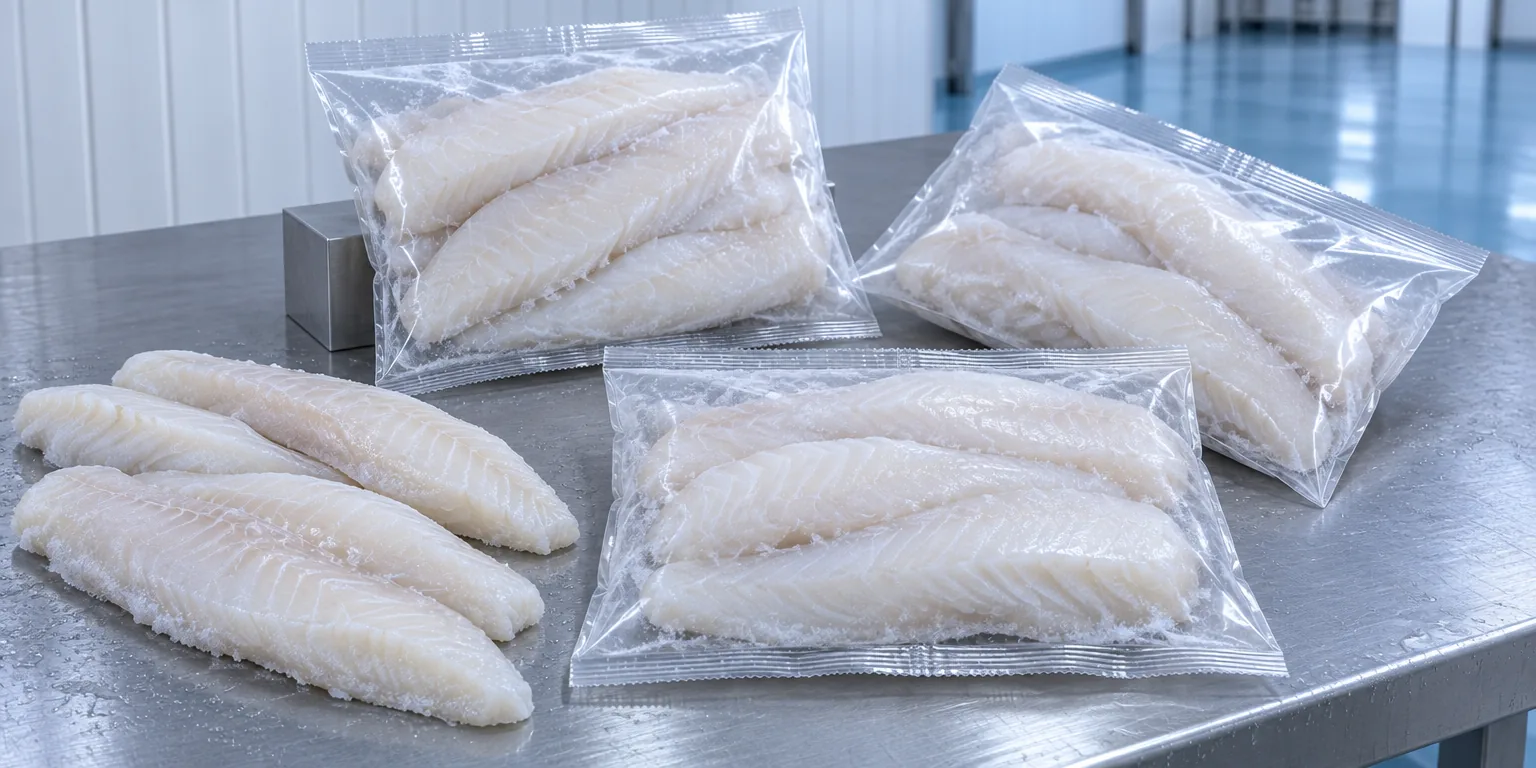
What a Frozen Fish Fillet Line Looks Like
A typical line for bagged frozen fillets has five stages:
- Feeding: a buffer and a transfer conveyor bring the fillets to the weigher.
- Weighing: a multihead weigher configured for frozen food makes up each pack.
- Bagging: a vertical form fill seal machine forms, fills and seals the bag. Our SVC260 runs in continuous motion and makes pillow bags, or side gusset bags with the optional gusset assembly.
- Inspection: checkweighing, and metal detection or X-ray depending on the product and film.
- Case packing and palletizing.
The route is the same one we use for other frozen fish products, from portions to fish balls. What changes with fillets is how each stage is set up. See our frozen fish packing line for the full route, or our seafood packing machines for other seafood products.
Where Fillets Break
A frozen fillet is brittle. Tails and thin edges snap when the fillet falls too far or lands on a hard edge, and a broken fillet lowers the value of the pack even when the weight is right.
On a bagging line, the fillet drops several times:
- from the conveyor into the weigher's feed buckets,
- through the weigh hoppers and the discharge chute,
- and from the forming tube into the bag.
Each drop can be shortened or softened, but the bagger also needs the product to arrive quickly enough to keep up its pace. A line set for maximum speed with long drops will often pack more bags per minute and more broken fillets. So the setup is a balance, and it can only be judged with real fillets at the target speed.
Watch the last drop in particular. In a pillow bag, the fillets fall the length of the forming tube and land on the bottom seal of the bag. The longer the bag, the further they fall.
Long Pieces, Few per Pack
Most frozen products are small pieces. A 1 kg bag of peas holds thousands of them, so the weigher has plenty of combinations to choose from and lands close to the target. Fillets are the opposite. A bag may hold only a handful, and each one weighs a lot compared with the pack.
That causes two problems. The first is weight. With few pieces per pack, one fillet more or less moves the weight a long way. The weigher can still combine hoppers to get close, but the giveaway tends to be higher than with small pieces. The number of heads, the hopper size and the target weight have to be chosen together. A larger target weight, or fillets sorted into size grades before weighing, can help.
The second is flow. Long fillets can bridge across buckets and chutes sized for small pieces and stop the flow. The hopper size and the chute have to suit the length of the fillet, not just its weight.
If you are still deciding on the doser, Multihead Weigher vs Cup Filler vs Auger Filler explains why fillets are weighed rather than dosed by volume.
Choosing the Bag for the Fillet
Start from the longest fillet you pack. The bag has to hold it lying in the direction it falls, with room above it for the top seal. On the SVC260, bags can be up to 260 mm wide and 400 mm long, so long fillets and small whole fish are checked against the bag size before anything else is fixed.
Pillow or side gusset
A pillow bag is the standard format on the SVC260 and the simplest to make. A side gusset bag holds more for the same face size, which can suit larger packs. It needs the optional gusset assembly. See how pillow, side gusset and quad-seal bags compare.
Film
Fins, bones and hard frozen edges can puncture thin film, and the risk grows with heavier packs. The SVC260 runs film from 0.04 to 0.10 mm. Choose the film for the fish and the pack weight, then confirm it in a test with real fillets, including how the bags behave in the case.
Glaze and Coated Fillets
Glazed fillets bring the same issues as glazed shrimp: the glaze adds weight, sheds ice on every drop, and that ice can end up in the seal. How to deal with the glaze in the target weight is covered in How to Package IQF Frozen Shrimp, and how ice and fragments cause leaking seals is covered in Why Frozen Food Bags Leak at the Seal.
Breaded and battered fillets shed crumbs instead. The crumbs build up on contact surfaces and can reach the seal area, so seal checks and a cleaning routine matter as much as the weigher setup.
What to Send for a Packaging Test
The fastest way to know how your fillets will run is to send them. Our packaging test is free; you cover the shipping of your samples. Send:
- frozen fillets, in the condition and temperature they reach the packing line
- fillet length range and whether they are size graded
- glazed, unglazed, breaded or battered
- target fill weight
- bag dimensions and film, or a bag sample
- required good output, in bags per minute or kg/h
We check breakage at each drop, weighing stability and giveaway against your target, how the fillets fit the bag, and seal quality, then send you a test video and a written record.
Questions to Ask Any Supplier
- How many drops do my fillets go through, and how high is each one?
- What giveaway should I expect at my target weight, with my fillet size?
- Which weigher heads and hopper size do you recommend for long pieces, and why?
- What is the longest fillet the bag can hold?
- Which film do you recommend for fins and hard edges at my pack weight?
- Will you test my fillets at my target speed before I order?
FAQ
Can a multihead weigher pack whole fillets without breaking them?
Often, if the drops are short and the transfers are soft. Breakage depends on the fillet, its temperature and the line speed, so it has to be checked with your fillets in a test.
Why is giveaway higher with fillets than with small frozen products?
Because there are only a few pieces in each pack. The weigher has fewer combinations to choose from, so it cannot always land as close to the target. Size grading or a larger target weight can help.
What is the longest fillet the SVC260 can pack?
The SVC260 makes bags up to 400 mm long and 260 mm wide. The usable fillet length is less than the bag length, because the bag needs room for the seals and for the fillet to fall in cleanly. We confirm it with your fillets.
Can the same line pack fillets and fish balls?
It can, with a changeover. Weigher settings, forming parts and bag size change with the product, so every product the line will run is tested.
Test Your Fillets Before You Order
Send your fillets, target weight and bag. We run them on the machine and show you the breakage, weight and seal results before the configuration is fixed.
Request a Packaging Test