
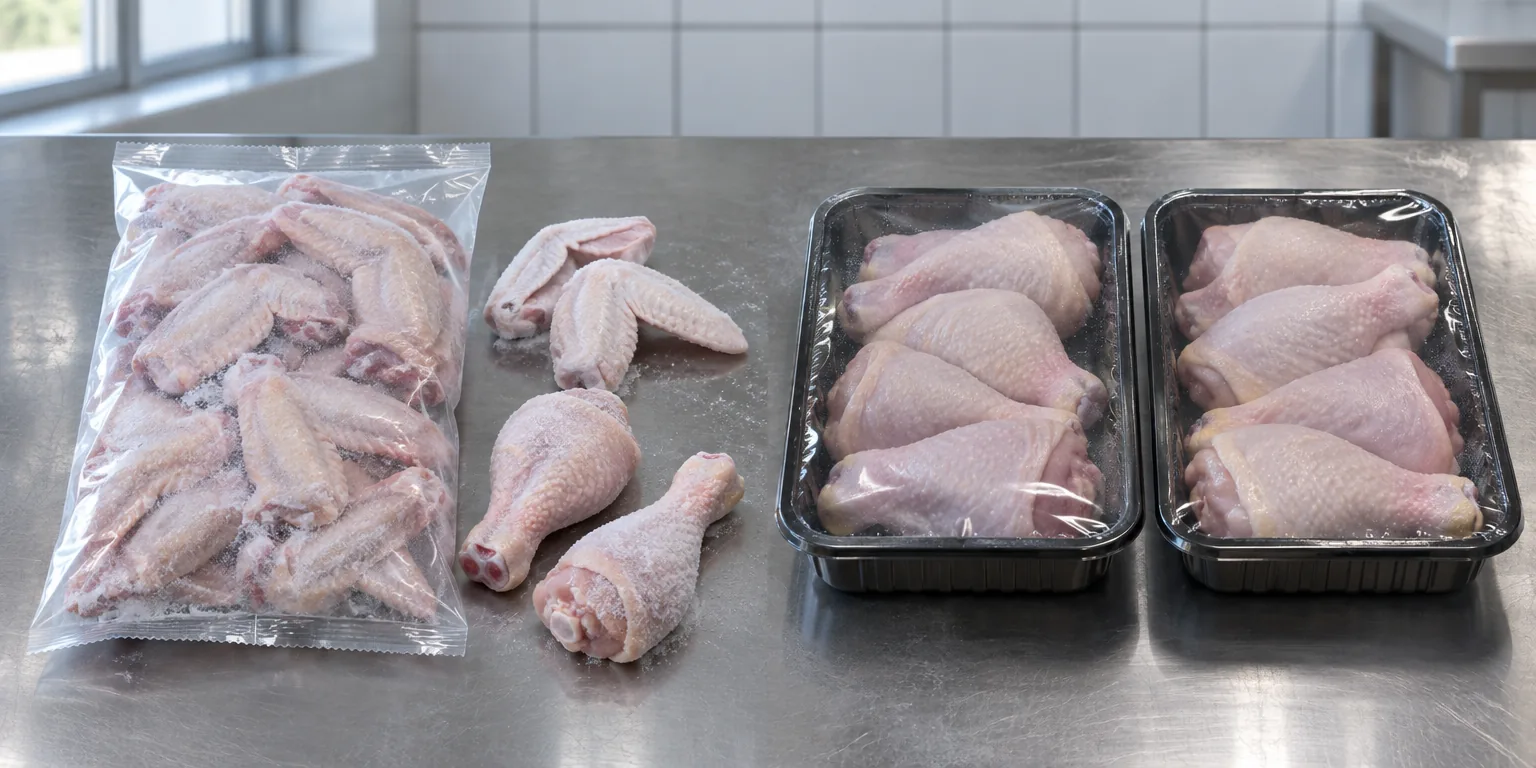
Frozen or Fresh: Start Here
| Frozen chicken parts | Fresh chicken | |
|---|---|---|
| Typical package | Pillow or side gusset bag | Sealed tray |
| How it is filled | Weighed by a multihead weigher, dropped into a bag | Placed in trays by hand or automatically |
| Machine | Vertical form fill seal bagger | Tray sealer |
| Main risks | Weight giveaway, bones piercing the film, frost in the seal | Drip on the tray flange, product height, gas mix |
Bagging and tray sealing need different machines, so a plant that packs both usually runs two lines. The first step is to decide which products go where. Our poultry packaging machines page shows how the two routes fit together.
Chicken Wings and Legs: Packing Frozen Parts in Bags
A frozen chicken parts line follows the same route as other frozen products:
- Product feeding from the freezer outfeed to the weigher.
- Multihead weighing, with the weigher hoppers and target weight chosen for wings and legs.
- Bagging on a VFFS machine. Our SVC260 makes pillow bags, or side gusset bags with the gusset assembly.
- Inspection: checkweighing and metal detection.
- Case packing.
What makes chicken parts harder than peas or nuggets comes down to four things.
Few large pieces per bag. A bag of wings or legs holds a handful of pieces, so one piece more or less moves the weight a long way. The weigher heads and hopper size have to be chosen together with the target weight, and size grading before weighing can reduce giveaway. How to Pack Frozen Fish Fillets explains the same problem for another product with few large pieces.
Bones and hard frozen edges. Bone ends and frozen tips can pierce thin film, and the risk grows with heavier packs. The SVC260 runs film from 0.04 to 0.10 mm; the film is chosen for the product and pack weight and confirmed with real pieces.
Frost, ice and clustering. Frost and ice fragments shed on every transfer and can reach the seal area. Pieces that wait on the line or start to thaw freeze together and bridge in hoppers. Feeding, weighing and bagging rates have to be matched so the product keeps moving.
Bag size. Legs in particular are long. On the SVC260, bags can be up to 260 mm wide and 400 mm long, so the longest piece and the pack weight are checked against the bag size before anything else is fixed.
Poultry plants are often washed down hard. The SVC260 is available with IP65, IP66 or IP69 protection on request; IP Ratings for Food Packaging Machines explains how to choose.
Packing Fresh Chicken in Trays
Fresh chicken is packed like fresh meat: in trays sealed with a lidding film. There are three common modes:
- MAP (modified atmosphere packaging): the tray is evacuated and filled with a gas mix before sealing.
- VSP (vacuum skin packaging): the top film is formed closely around the product.
- Seal-only: the film is sealed onto the tray without changing the atmosphere.
Our Hybrid Pro T680 runs all three modes on plastic or paper-based trays, with automatic tray feeding, up to 20 cycles/min in MAP, 12 in VSP and 25 in seal-only (machine maximums). For smaller batches and frequent product changes, the semi-automatic M-450 seals MAP trays loaded by hand, at a nominal 2–3 cycles/min.
Chicken is harder to tray-pack than many fresh meat cuts:
- Skin and moisture. Chicken skin and drip easily touch the tray flange during loading, and anything left there weakens the seal. Loading has to keep the flange clean.
- Irregular shapes. Wings and legs do not lie flat. A piece that rests on the rim or rises above the tray gets pressed into the seal, so tray depth and loading pattern are set for the pieces you pack.
- Bone ends. Exposed bone ends can pierce the lidding film, and the effect is strongest in VSP, where the film is drawn tight around the product.
- Gas, tray and film together. The gas mix is set for each product in testing, and the tray material, flange and lidding film have to seal reliably with it.
Fresh Meat MAP Packaging goes deeper into the tray route.
Which Machine for Which Chicken Product
| Product | Package | Machine |
|---|---|---|
| Frozen wings and legs | Pillow or side gusset bag | SVC260 continuous-motion VFFS |
| Frozen nuggets and other coated products | Pillow bag | SVC260, see Chicken Nugget Packaging |
| Fresh chicken, continuous production | MAP, VSP or seal-only tray | Hybrid Pro T680 |
| Fresh chicken, smaller batches | MAP tray | M-450 semi-automatic |
What to Send for a Packaging Test
For frozen parts:
- frozen samples, in the condition they reach the packing line
- the size range of the pieces, and whether they are graded
- target fill weight
- bag dimensions and film, or a bag sample
- required good output
For fresh chicken:
- the product and its condition
- tray samples or a drawing, and the lidding film
- the packaging mode, and any gas mix you already use
- required output
The packaging test is free; you cover the shipping of your samples. We run them on the machine and send you a test video and a written record.
Questions to Ask Any Supplier
- Will my frozen parts and my fresh products run on separate lines, and which machine is proposed for each?
- What giveaway should I expect at my target weight with my piece size?
- Which film do you recommend for bone ends and frozen edges?
- How is drip on the tray flange handled, and which packaging mode suits my product?
- Which protection rating does the machine have for my cleaning routine?
- Will you test my chicken, bags or trays before I order?
FAQ
Can one machine pack both frozen and fresh chicken?
Not usually. Frozen parts are weighed and bagged on a VFFS line; fresh chicken is sealed in trays on a tray sealer. Most plants that pack both run two separate lines.
How are frozen chicken wings packaged for retail?
Commonly in bags filled by a multihead weigher on a vertical form fill seal machine; on our SVC260 these are pillow or side gusset bags. The bag size, film and target weight are set for the wings and confirmed in a test.
Can chicken bones pierce the bag?
They can, especially with heavier packs and thin film. The film is chosen for the product and pack weight and checked with real pieces before the configuration is fixed.
Which tray sealer suits a small fresh chicken line?
For smaller batches and frequent product changes, the semi-automatic M-450 seals MAP trays loaded by hand. For continuous production, the T680 adds automatic tray feeding and also runs VSP and seal-only.
Test Your Chicken Before You Order
Send your frozen parts or fresh product with your bags or trays. We run them on the machine and show you the weight, seal and package results before the configuration is fixed.
Request a Packaging Test