
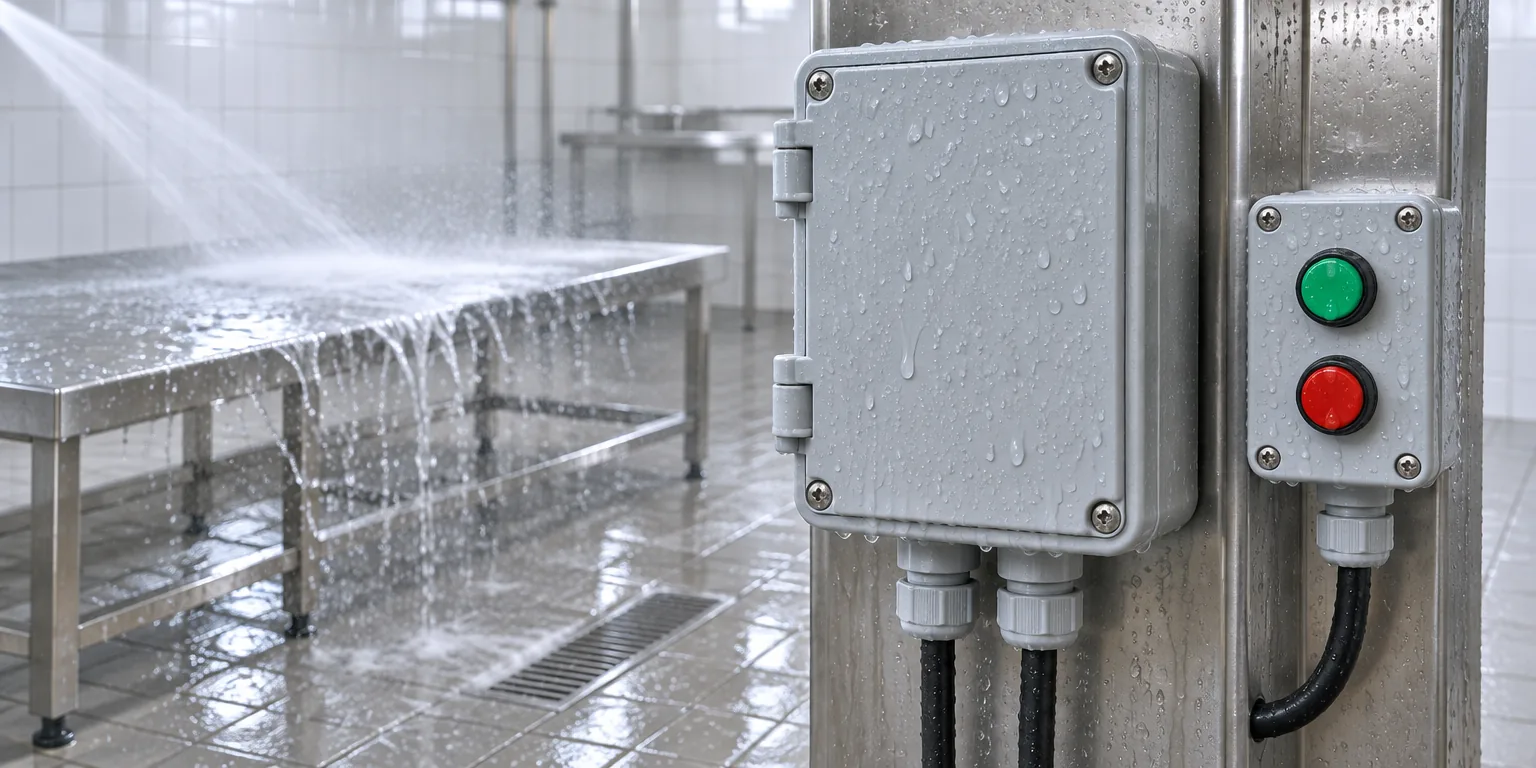
What the Two Digits Mean
IP stands for ingress protection, and ingress protection ratings are defined in the international standard IEC 60529. The code is always "IP" followed by two digits:
- The first digit is protection against solid objects and dust, from 0 to 6. A 6 means the enclosure is dust-tight.
- The second digit is protection against water, from 0 to 9. Higher numbers mean stronger water exposure in the test, from dripping water up to high-pressure, high-temperature jets.
So IP65 means dust-tight and protected against water jets. An "X" in place of a digit, as in IPX5, means that part was not tested.
The second digit is not a simple ladder. A rating for immersion (7 or 8) does not automatically cover water jets (5 or 6), so a component can carry two ratings, such as IP66/IP67.
IP65, IP66 and IP69 Compared
These are the three ratings you will meet most often on food packaging machines. All three are dust-tight; they differ in the water test.
| Rating | Dust | Water test | Typical use in food packing |
|---|---|---|---|
| IP65 | Dust-tight | Water jets from a nozzle | Dry products, cleaning by wiping and light rinsing |
| IP66 | Dust-tight | Powerful water jets | Areas rinsed with a hose |
| IP69 | Dust-tight | High-pressure, high-temperature water jets at close range | Washdown areas cleaned with high-pressure hot water |
You may also see IP69K. It comes from standards for road vehicles (ISO 20653, and before it DIN 40050-9) and describes a similar high-pressure, high-temperature test. IP69 was added to IEC 60529 later. If a specification asks for IP69K, ask whether IP69 to IEC 60529 is accepted.
Which Rating for Which Packing Area
Start from how the area is cleaned, not from the highest number available. Your hygiene plan or auditor sets the final requirement.
- Dry products such as nuts, rice, grains, seeds and dry pet food are usually cleaned by vacuum, brush and wiping. Water is kept away from the product, and IP65 is normally enough.
- Frozen foods are packed in cold, sometimes wet rooms. Frost, condensation and ice from glazed products all bring water near the machine, and cleaning often uses a hose. IP65 or IP66 is common, depending on the cleaning routine.
- Seafood and fresh meat areas are usually washed down hard at the end of each shift. This is where IP66 and IP69 come in.
Higher ratings cost more, and they can make some parts harder to reach for maintenance. If your plant never uses high-pressure hot water on the machine, IP69 adds cost without adding protection you will use.
What an IP Rating Does Not Tell You
An IP rating is a laboratory test of an enclosure against dust and water. It says nothing about:
- Hygienic design: whether the frame has ledges, gaps and hollow sections where product and water collect.
- Materials: which parts are stainless steel, which grade, and how plastics and seals hold up.
- Chemical resistance: whether seals, cables and labels survive your cleaning chemicals.
- Every component: a machine is only as protected as its weakest part. Check motors, sensors, push buttons, the HMI and cable entries, not just the main cabinet.
- Your cleaning procedure: spraying directly into seals or cable glands at close range can damage even a well-rated machine.
Ask for the rating of the parts that will actually be exposed, and for the cleaning instructions in the manual. VFFS Troubleshooting covers how cleaning and moisture show up as sensor and heater faults.
IP Ratings on Our Machines
Protection is chosen per project, based on your product and how your area is cleaned.
| Machine | Protection |
|---|---|
| SVC260 continuous-motion VFFS | IP65, IP66 or IP69 on request. Our only bagger available up to IP69. |
| VP Series compact VFFS | IP65 on request |
| VGT quad-seal VFFS | IP65 on request |
| Hybrid Pro T680 tray sealer | Built to IP65, with IP66 on request |
For a seafood or frozen line that is washed down with high-pressure hot water, the SVC260 is the bagger to start from. Product-contact parts on the SVC260 are SUS304 stainless steel. Our VFFS machines page compares the three baggers in more detail.
Questions to Ask Any Supplier
- Which IP rating does the whole machine meet, and to which standard?
- Which components are rated lower than the main enclosure?
- Is the rating tested, or based on the ratings of the components?
- How should the machine be cleaned, and what water pressure and temperature are allowed?
- Which cleaning chemicals are the seals and cables compatible with?
FAQ
What is the difference between IP65 and IP66?
Both are dust-tight. IP65 is tested with water jets, IP66 with more powerful water jets. IP66 suits areas rinsed with a hose; IP65 suits drier areas.
Is IP69 the same as IP69K?
They describe similar high-pressure, high-temperature water tests but come from different standards. IP69 is in IEC 60529; IP69K comes from vehicle standards. Ask your customer or auditor which one they require.
Does a higher IP rating mean a more hygienic machine?
No. The IP rating covers dust and water entering enclosures. Hygienic design, materials and how easily the machine can be cleaned are separate questions.
Which of your machines can be built to IP69?
The SVC260 continuous-motion VFFS, on request. The VP Series and VGT can be built to IP65, and the Hybrid Pro T680 tray sealer is built to IP65 with IP66 on request.
Tell Us How Your Area Is Cleaned
Send your product, package and cleaning routine. We recommend the machine and protection level, and test your product before the configuration is fixed.
Request a Packaging Test