
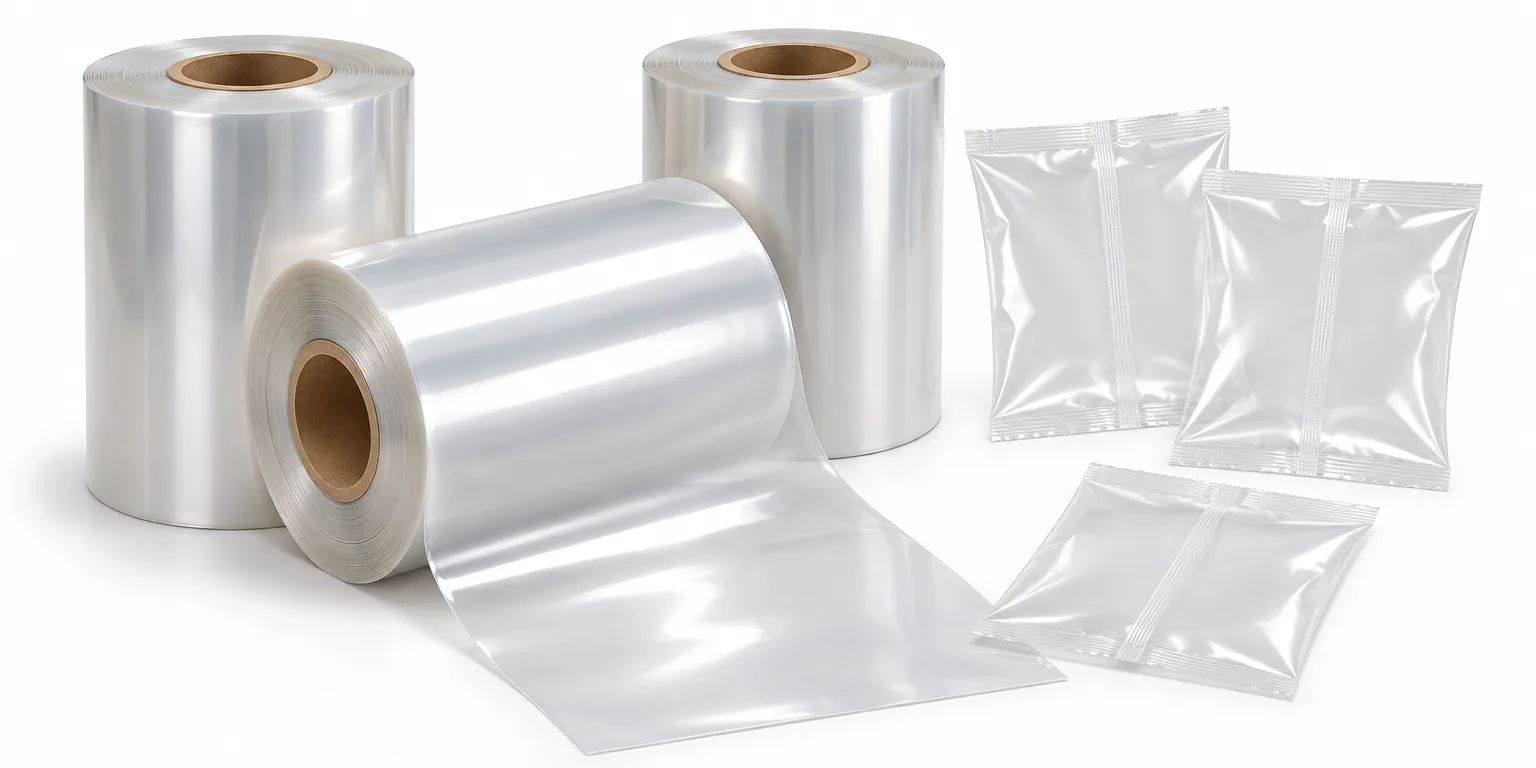
What COF Means
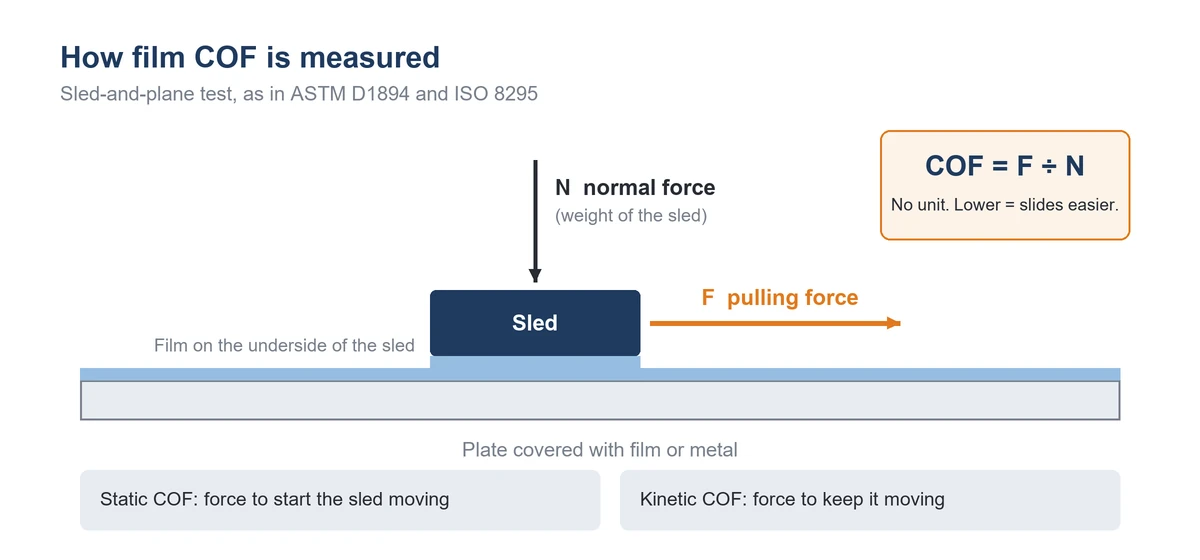
The coefficient of friction is the force needed to slide one surface over another, divided by the force pressing them together. It has no unit. A low number means the surfaces slide easily; a high number means they grip.
Film suppliers usually quote two values:
- Static COF: the force needed to start the film moving.
- Kinetic COF: the force needed to keep it moving once it slides.
Static COF is normally the higher of the two. On a packaging machine both matter, because the film starts and stops (on an intermittent bagger) or changes speed (on any bagger during start-up and changeovers).
COF also depends on which surfaces touch. A datasheet may give film-to-film COF, film-to-metal COF, or both, and the inside and outside of a laminate are often different. Ask which surfaces each number refers to.
How COF Is Measured
The common test drags a weighted sled covered with film across a flat plate covered with film or metal, and records the force. The standard methods are ASTM D1894 and ISO 8295. They are not identical, so two numbers measured to different standards should not be compared directly.
The test conditions matter as much as the method. COF changes with temperature, with how long the film has been stored, and with the slip additives in the film, which can move to the surface over time. A COF measured on fresh film at room temperature may not be what you see on the machine weeks later, or in a cold packing room.
Where COF Shows Up on a VFFS Machine
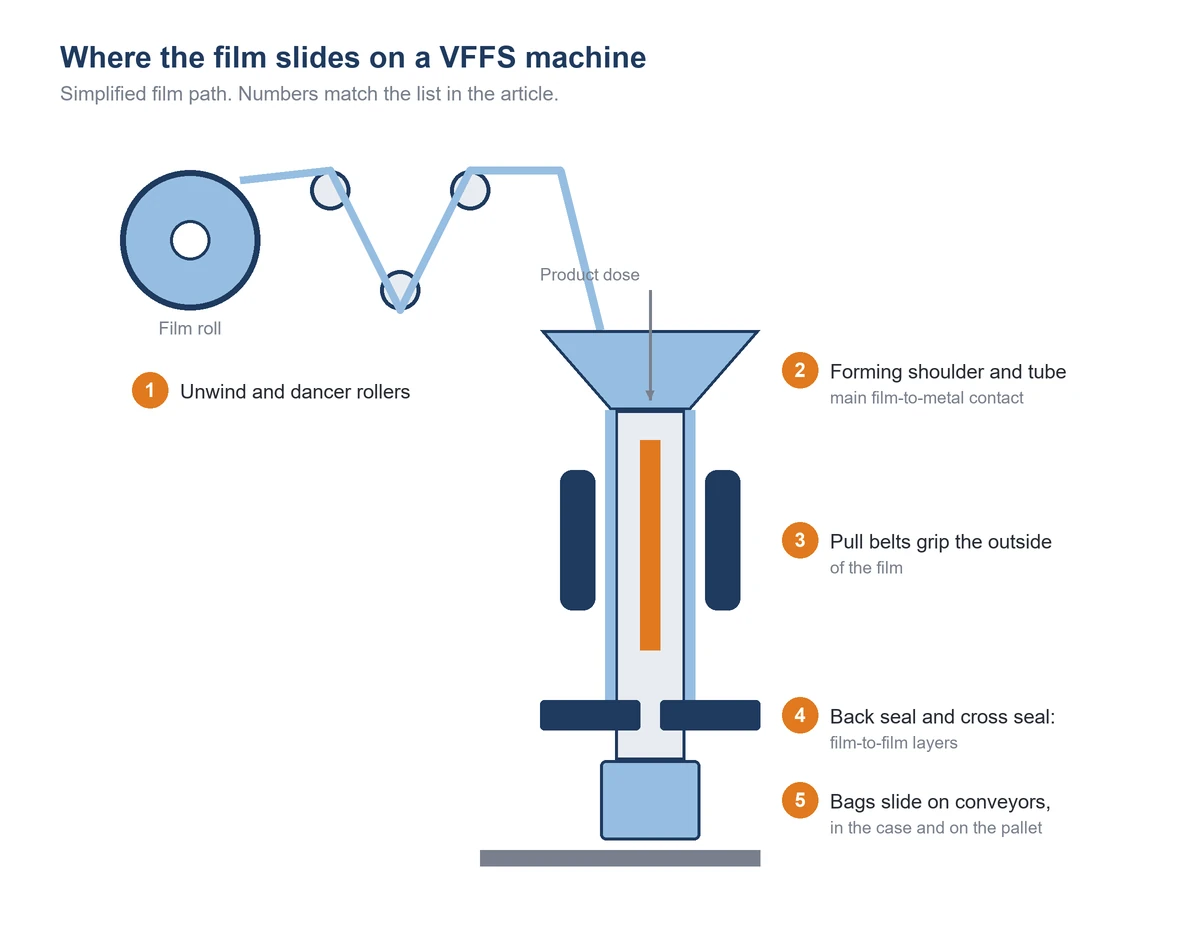
The film touches metal and itself at several points on every cycle:
- Unwind and dancer rollers: the film is held under tension as it comes off the roll.
- Forming shoulder and tube: the flat film is wrapped around the tube and slides down over it. This is the main film-to-metal contact.
- Pull belts: belts grip the outside of the film and pull it down the tube by one bag length per cycle.
- Back seal and cross seal: the film edges meet and the jaws close on film-to-film layers.
- After the machine: finished bags slide on conveyors, against each other in the case and on the pallet.
On our VFFS machines, film feed is controlled at these points. The SVC260 uses color-mark sensing, film pulling and tension control to keep the film in register. The VGT uses a short film path, self-centering pull belts, automatic film tracking, a VFD-controlled unwind, a photo eye and an encoder, with static elimination as an option.
What Happens When COF Is Wrong
There is no single "right" COF. What works depends on the film structure, the machine, the bag size and the product. But films that are far too grippy or far too slippery for the machine cause recognisable problems. Use the table as a checklist, not a diagnosis.
| Symptom | Possible COF cause |
|---|---|
| Film drags or wrinkles at the forming shoulder | Film-to-metal COF too high on the inside surface |
| Film stretches or breaks under tension | High drag at the shoulder and tube |
| Bag length varies, print drifts out of register | Pull belts slipping on an outside surface that is too slick |
| Film wanders sideways on the tube | Uneven friction across the web, or COF changing roll to roll |
| Bags slide off each other in the case or on the pallet | Film-to-film COF on the outside too low |
| Rolls telescope or shift in storage | Film-to-film COF too low between wraps |
COF is rarely the only cause. Tension settings, worn pull belts, a damaged forming shoulder, static and film thickness variation can produce the same symptoms. When a line that ran well starts to drift or wrinkle on a new batch of film, comparing that batch's COF with the old one is a quick first check.
COF, Slip Additives and Sealing
Many films get their low COF from slip additives that migrate to the surface. These help the film run, but more is not always better. Additive on the sealing surface can make good seals harder to achieve, and on the print surface it can affect ink and adhesive bonding. Paper-based and mono-material films behave differently again, because their surfaces and stiffness differ from conventional laminates.
If you are changing to a new film structure, especially a recyclable or paper-based one, test it on the machine with your product before you order in volume. Seal problems that look like a jaw setting can turn out to be the film. Why Frozen Food Bags Leak at the Seal covers the other common causes.
Cold Rooms and Frozen Products
Frozen food lines bring two extra effects. Film stored warm and used in a cold packing room can behave differently from the datasheet, and condensation on the film or the forming tube changes how it slides. Glaze ice and frost on the product can also reach the film surfaces. If you pack frozen products, let the film reach the packing room temperature before running it, and include this in any trial.
Questions to Ask Your Film Supplier
- What are the static and kinetic COF values for the inside and outside surfaces?
- Which test standard was used, and at what temperature and film age?
- How much does COF vary between rolls and between batches?
- Which slip additives are used, and do they affect sealing or printing?
- Has this film run on a vertical form fill seal machine with a similar product and bag size?
Questions to Ask Any Machine Supplier
- What film range does the machine run, by thickness and type?
- How is film tension controlled, and how is registration held?
- What pull belt material is used, and how often is it replaced?
- Is static elimination available?
- Will you run my film and my product on the machine before I order?
FAQ
What does COF mean in packaging?
COF stands for coefficient of friction. It describes how easily a film slides over another surface, such as metal parts of a packaging machine or another layer of film. A lower number means it slides more easily.
What is the difference between static and kinetic COF?
Static COF is the friction you have to overcome to start the film moving. Kinetic COF is the friction while it is already moving. Static COF is usually higher.
Can a VFFS machine be adjusted for a film with high or low COF?
Within limits. Tension, pull belt pressure and forming parts can be adjusted, but a film far outside what the machine was set up for will keep causing problems. It is better to confirm the film and the machine together in a test.
Which films can your VFFS machines run?
The SVC260 runs laminates, foil and paper-based films from 0.04 to 0.10 mm thick, and mono-material film is available as a custom build. The VGT runs film from 0.04 to 0.10 mm, and the VP Series runs film widths from 90 to 520 mm depending on the model. We confirm the exact film in a packaging test.
Test Your Film Before You Order
Send your film rolls, product and bag size. We run them on the machine, check tracking, bag length and seals, and send you a test video and a written record.
Request a Packaging Test